Race Cycling Apparel Development and Sampling for Brands, Federations and Race Teams
We develop race cycling apparel for cycling brands, federations and race teams: pattern and panel map, fabric by panel, a signed colour card for every base fabric, measured samples and an eight-part spec pack that you own and can put straight into production.
For product leads at cycling brands · technical directors at federations · technical leads at race teams
Your garment list, size range and target race conditions.
Within 48 hours
A development feasibility review: whether we can build each garment to spec, the pattern and fabric direction we recommend, and a sampling plan with dates.
Development, Sampling and Spec Pack Services for Race Apparel Programmes
Each service can be booked on its own or run together as one project, and one development manager is your contact from the first message onward.
01
Race-fit pattern and panel development
You send
Your garment list, size range, fit brief, race format and the temperature range the kit will be raced in.
We do
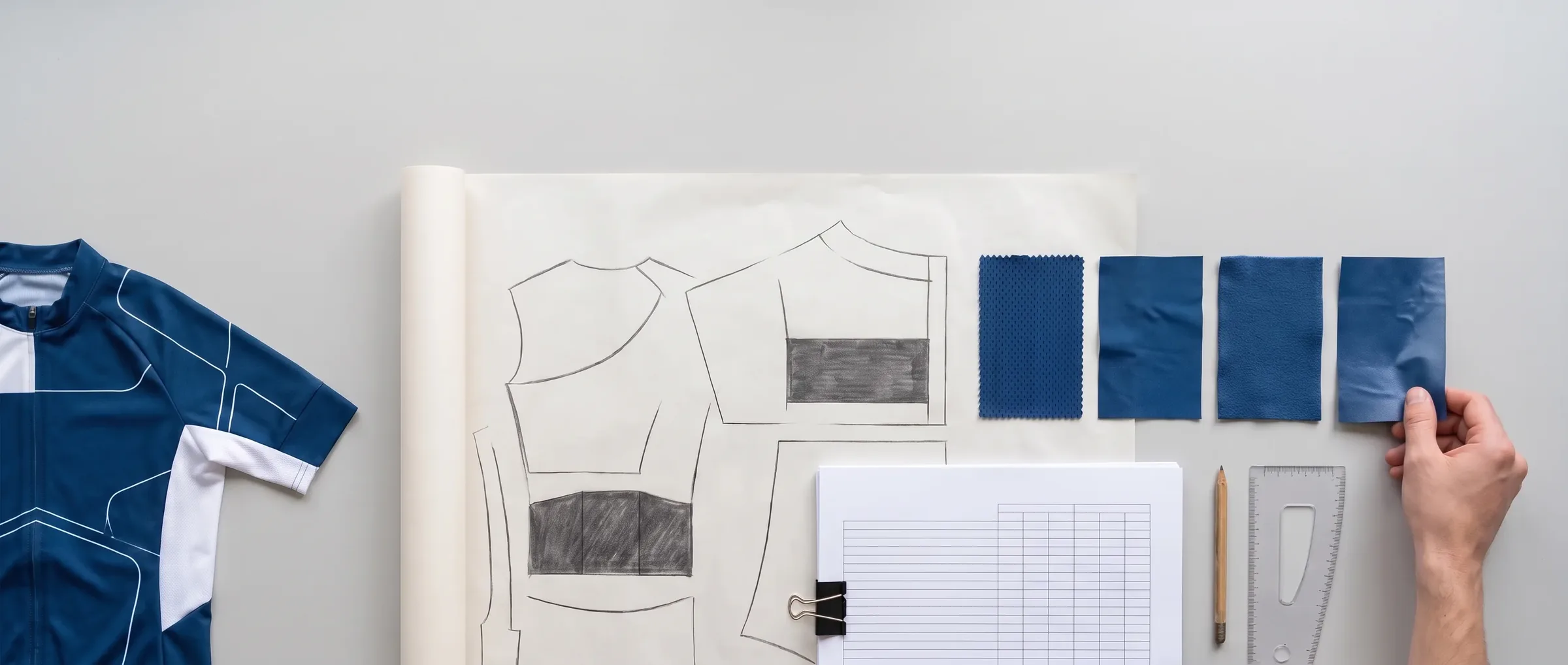
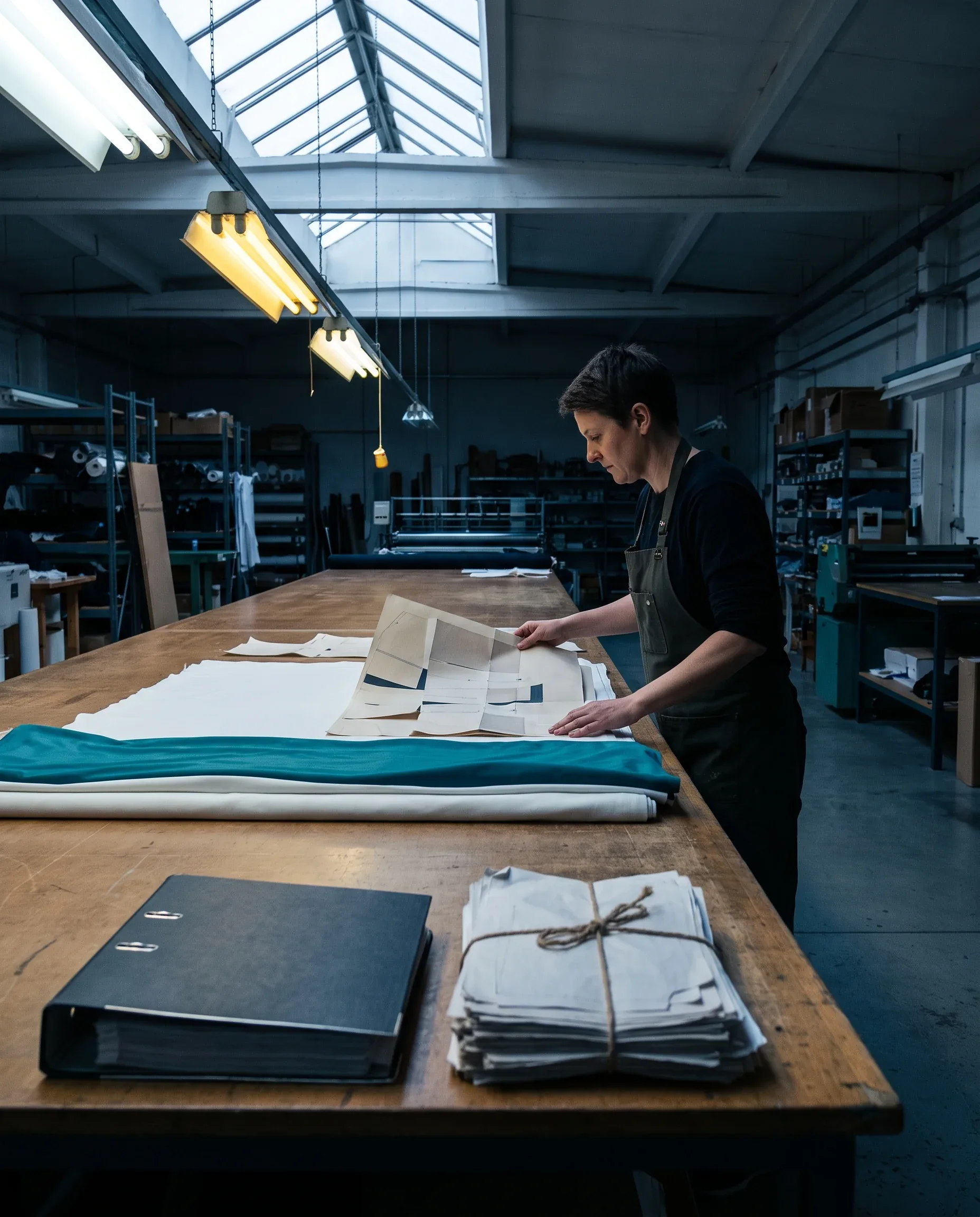
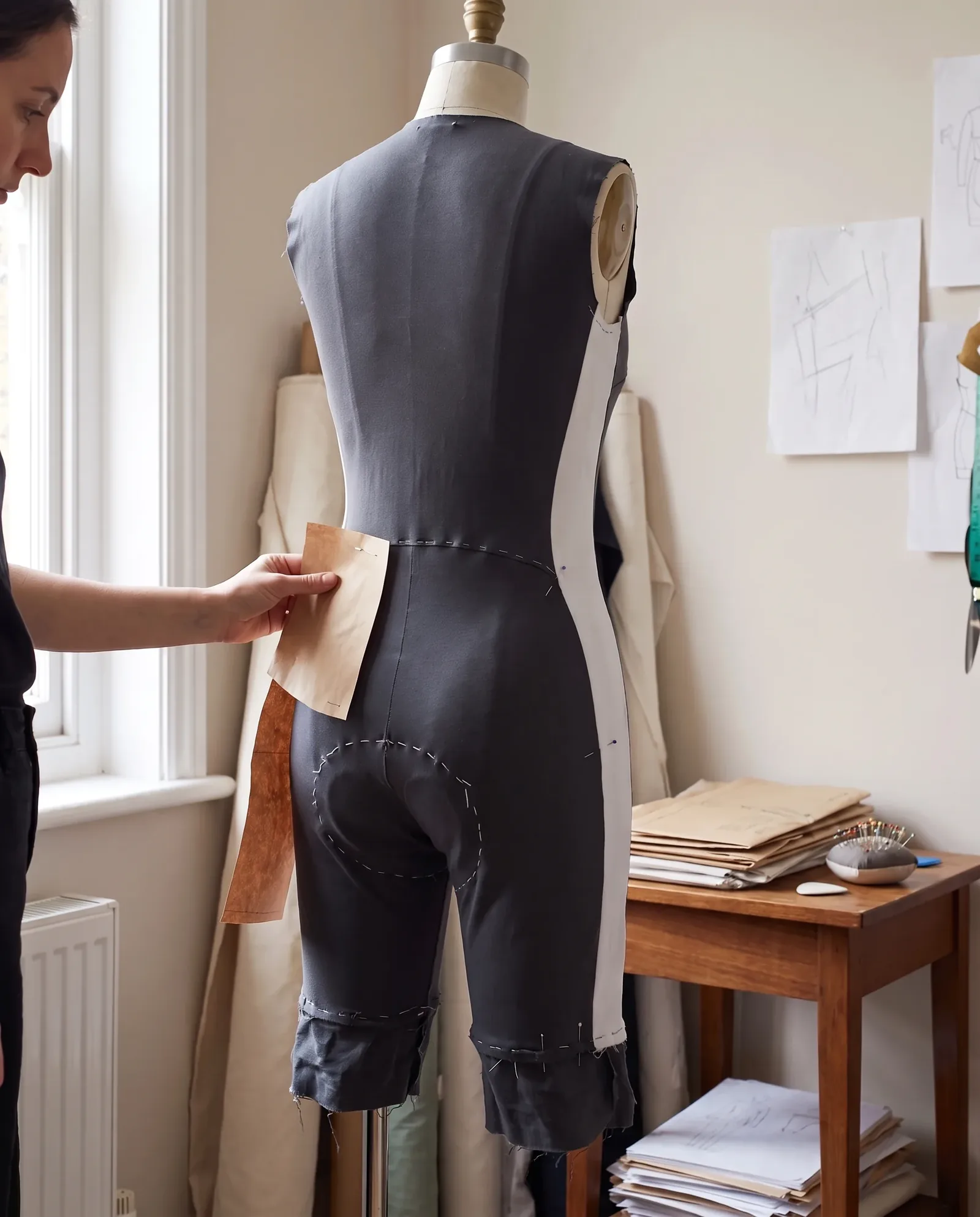
The pattern maker drafts a base block in the riding position, builds the panel map and assigns a fabric weight or finish to each panel.
You receive
The panel map showing every panel, its fabric and its seam type, with flatlock on contact zones and four-thread overlock on main-body joins.
After fit sign-off
You also receive the graded pattern files. The pattern maker signs the fit check on every sample.
Timing
The panel map is issued before the first sample is cut. The first sample takes 5–7 days.
02
Sampling, measurement reports and revision rounds
You send
Approval of the sampling plan, your artwork and your colour standard.
We do
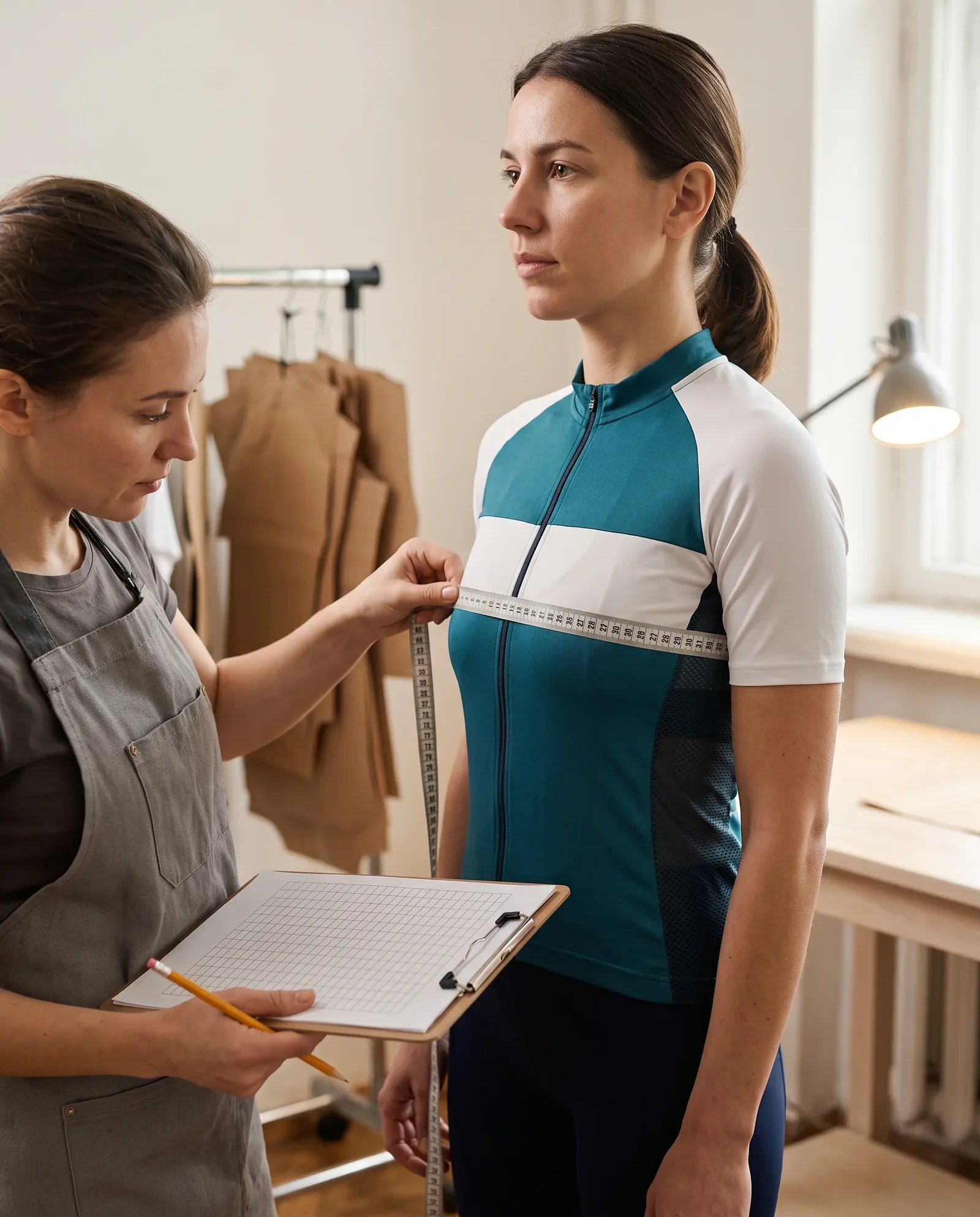
We cut and sew the sample from the panel map. Before it ships, the sample technician measures it point by point against your size chart.
You receive
The sample, the panel map it was cut from, and a measurement report signed by the pattern maker for fit and the sample technician for measurements.
Revisions
You mark changes against the report. Every round is logged by panel, change and reason, and the first 2 rounds carry no extra sampling fee.
Timing
First sample in 5–7 days. A change to the confirmed spec starts a new sampling cycle.
03
Colour matching on every base fabric in the kit
You send
Your colour standard as a physical swatch or a colour-system reference, with your artwork.
We do
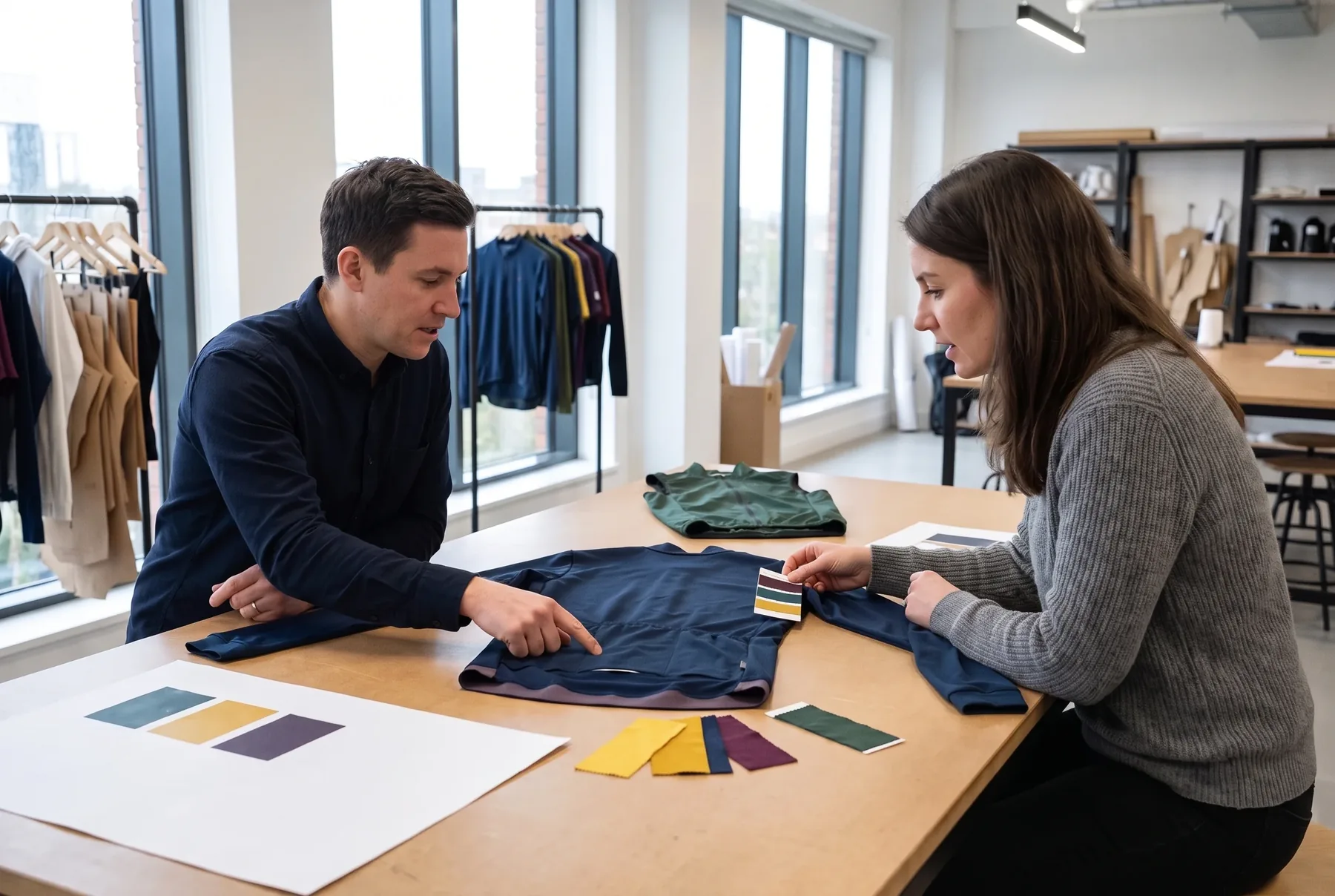
The colour and print technician prints a strike-off on every base fabric in the kit, views them with your standard under D65 light and adjusts each fabric until it sits on your standard.
You receive
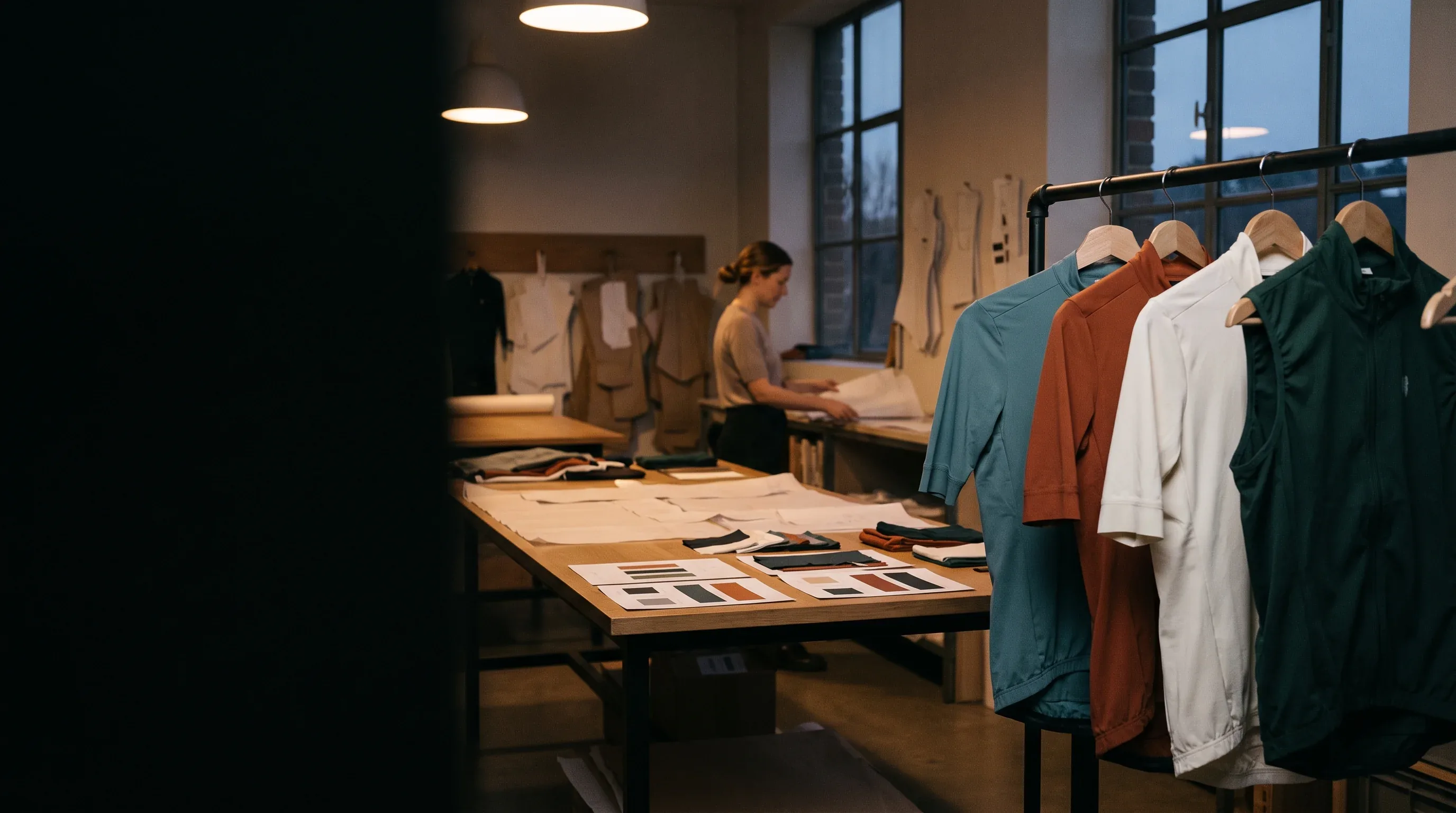
One physical colour card per base fabric, signed by the technician and naming the fabric, its blend and its finish.
A jersey, gilet and thermal jacket kit gives you four cards: mesh, main body, brushed thermal and laminate.
Timing
You sign the colour cards before the first sample is sewn. The colour parameters for each fabric go into the spec pack.
04
Eight-part spec pack, with files and revision log owned by you
You send
Your sign-off on the final sample and its measurement report.
We do
The development manager compiles the spec pack from the signed documents of the approved sample.
You receive
Panel map, graded pattern files, fabric specification for every panel, colour card and colour parameters for each base fabric, decoration placement sheet, size chart, seam construction sheet and the sample pack.
Ownership
The files and the revision log belong to you, and any production line can cut, print and sew from them.
Timing
Issued at sign-off.
05
Production handoff: your own line or cyclingapparelfactory.com
You choose
Your own production line, or bulk through cyclingapparelfactory.com, the production side of the same factory.
We do
The development manager hands the signed spec pack to you, or passes it to cyclingapparelfactory.com with your approval.
You receive
A spec pack that carries the colour parameters for each base fabric, with the signed colour cards and measurement report kept as the reference bulk is checked against.
Book one service or the full sequence. Send your garment list and tell us which services you need, and the feasibility review is scoped to them.
Three Engagement Models: Development to a Spec Pack, Development With Production Handoff, or Rework of an Existing Garment
You choose the model in your first message, and the feasibility review is written for that model.
01
Development to a spec pack for your own production line
We run the feasibility review, pattern and panel map, samples, colour cards, measurement reports and revision rounds. At sign-off the development manager issues the eight-part spec pack: cutting diagrams, graded patterns, fabric by panel, colour cards and parameters for each base fabric, decoration placement, size chart, seam types and the sample set.
The files and revision log belong to you. Your own production line can run from them directly.
02
Development with production handoff through cyclingapparelfactory.com
The development work and spec pack are the same as in the first model.
After you sign the spec pack, the files go to cyclingapparelfactory.com, the production side of the same factory, which runs bulk from the same graded patterns and the colour parameters for each base fabric.
03
Rework of a garment you already sell or race in
You send the current garment or its spec, with the changes you want in fit, fabric by panel, colour or decoration. The pattern maker starts from your existing garment instead of a new base block.
Samples, measurement reports, revision rounds and the spec pack follow the same steps as in the first model, and the production handoff can follow as in the second.
Clients We Develop For: Brands, Federations and Race Teams
We work with three types of client. Each type tends to book a different mix of services, and all three work with the same four development roles and receive the same signed documents.
Performance cycling brands
Product leads at brands that already sell cycling apparel and are adding a race line, a criterium series or a new layering range.
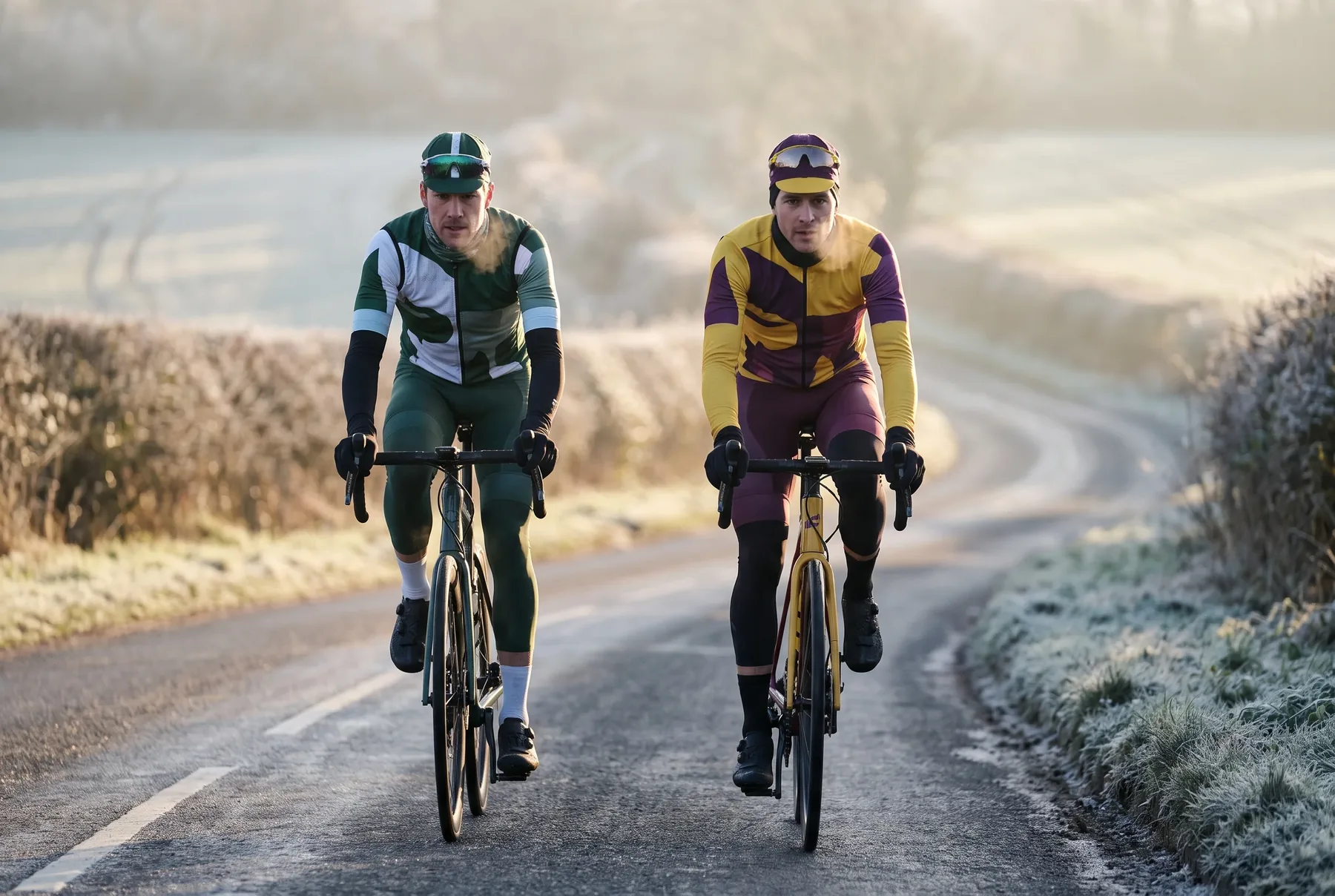
They usually book the full development sequence and take the spec pack to their own production line. The colour cards keep the new line on the brand's existing colour standard across every fabric.
National and regional cycling federations
Technical directors equipping several squads or several race formats in one season.
They book a separate pattern and fabric plan for each race format, one colour standard across every squad, and one spec pack per format. Bulk can go to their own supplier or through cyclingapparelfactory.com.
Competitive race teams and club race squads
Technical leads setting the season's race-day kit.
They often use the rework model on a garment the team already races in. Fit is checked on a rider in race position, and every sample arrives with a measurement report they can check against the signed size chart.
We develop for clients in the United States, the United Kingdom, Germany, France, the Netherlands, the Nordic countries and Australia.
Development Process: Six Steps With Input, Output, Timing and Owner
Each step has a named owner and a document you receive at the end of it.
Deliverables: The Documents You Hold at Each Stage
Every document below is signed by the role that owns it and stays with you after the project closes.
Feasibility review
What it shows
Whether each garment can be built to spec, recommended pattern and fabric direction, sampling plan with dates
Signed by
Development manager
When you receive it
Within 48 hours of a complete spec
Panel map
What it shows
Every panel, the fabric weight or finish assigned to it, every seam line and seam type
Signed by
Pattern maker
When you receive it
Before the first sample is cut, and with every sample
Colour cards
What it shows
One physical card per base fabric, naming the fabric, blend and finish
Signed by
Colour and print technician
When you receive it
Before the first sample is sewn
Measurement report
What it shows
Each point of measure, the target from the size chart, the reading on the sample, a pass or revise mark
Signed by
Pattern maker for fit, sample technician for measurements
When you receive it
With every sample
Revision log
What it shows
For each round: the panel changed, what changed and why
Signed by
Development manager
When you receive it
With every revised sample
Spec pack
What it shows
Eight parts, from panel map and graded patterns to the sample pack
Signed by
Development manager
When you receive it
At sign-off
The number of colour cards equals the number of base fabrics in your kit. The spec pack and revision log are yours to take to any production line.
Sign-Off Roles and Sample Checks Under ISO 9001:2015
Four development roles each sign the step they own, so every document you receive names the person responsible for it. The whole process runs inside our ISO 9001:2015 quality management system.
Pattern maker
Drafts the base block in the riding position, builds the panel map, adjusts fit in each revision round and signs the fit check on every sample.
Sample technician
Measures every sample point by point against the size chart before it ships and signs the measurement report.
Colour and print technician
Prints strike-offs on every base fabric, matches them to your standard under D65 light and signs the colour card for each fabric.
Development manager
Your single contact from the first message, issues the feasibility review, runs the revision rounds and signs off the spec pack.
Before a sample ships, the sample technician checks it against four references:
Every point of measure on the size chart, recorded line by line with a pass or revise mark.
Seam positions and seam types against the panel map.
Colour on each fabric against its signed colour card.
Decoration positions against the placement sheet.
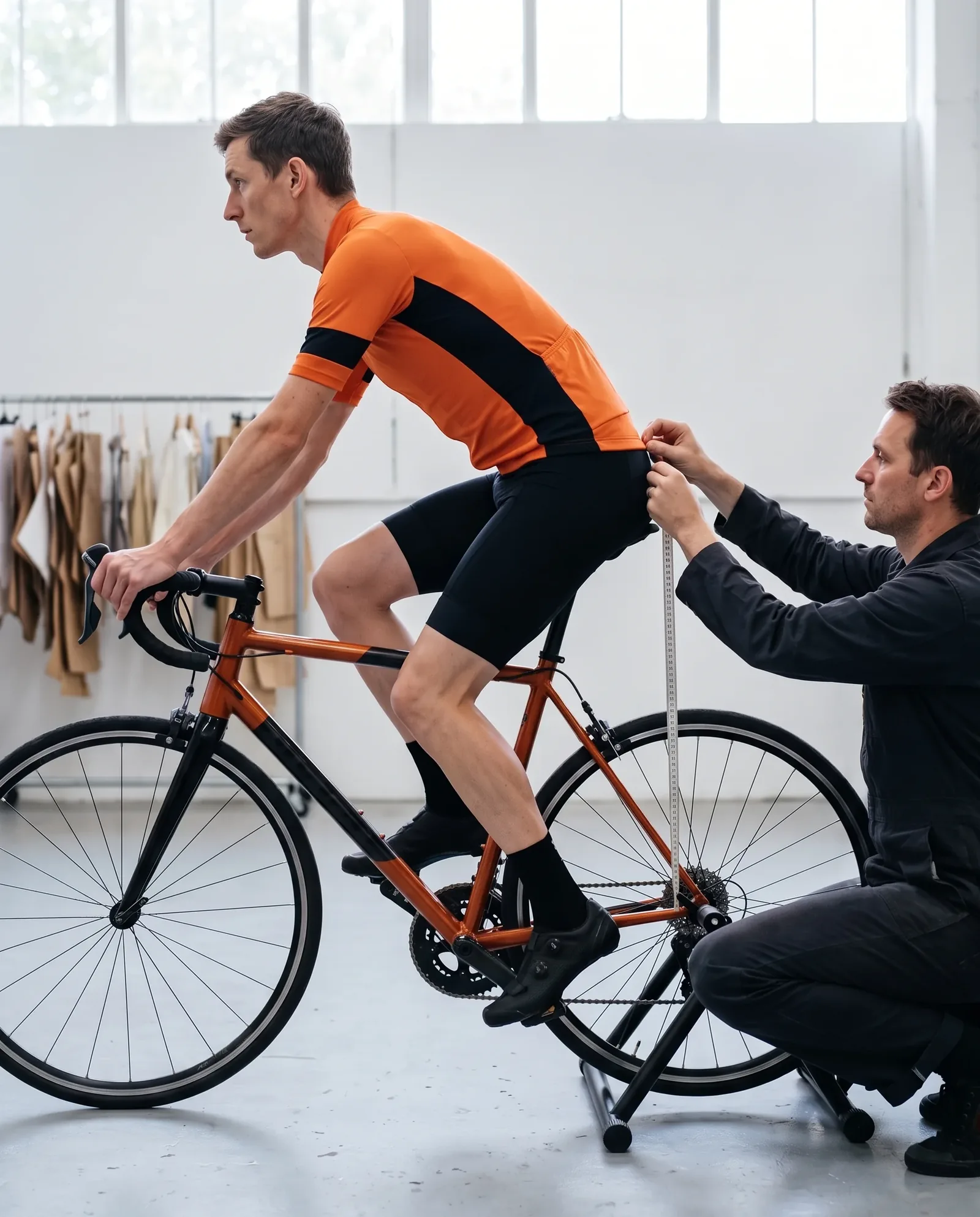
The pattern maker then puts the sample on a rider on the bike in race position and checks that the back hem stays down on the drops, the collar sits clear of the throat, the sleeve hem stays flat on the upper arm and the shoulders stay free. The fit check is signed after that.
When a sample misses the confirmed spec, the report shows which point, seam or colour missed, and that line sets the work for the next revision round. You can check any line yourself with a tape measure against the reading in the report.
Production Handoff: A Spec Pack Your Own Line or cyclingapparelfactory.com Can Run From
At sign-off the development manager issues the eight-part spec pack:
panel map
graded pattern files
fabric specification for every panel
colour card and colour parameters for each base fabric
decoration placement sheet
size chart
seam construction sheet
the sample pack
Your own production line
The spec pack is production-ready. Your own production line can cut, print and sew from it directly.
If you want bulk made in the factory that made your samples, the spec pack goes to cyclingapparelfactory.com, which handles production for the same factory.
Either way, printing runs from the same colour parameters for each base fabric, and the signed colour cards and measurement report stay with you as the reference the bulk is checked against.
The files and revision log belong to you. A repeat order or next season's kit starts from the same spec pack.
Product Scope: Six Race Garment Categories We Develop
Every garment is built in binary nylon-spandex in one of three blends, 88/12, 90/10 or 91/9, across four weights and finishes: lightweight summer mesh, mid-weight stretch main body, brushed-back thermal main body and windproof laminate. Fabrics carry OEKO-TEX® STANDARD 100 certification.
Race-fit jersey, short and long sleeve
Pattern
Riding-position block: extended back, shortened front, sleeves angled forward, collar dropped at the front
Fabric by panel
Main-body front and sleeves, mesh back and sides; brushed thermal for cold-weather long sleeves
Decoration
Full sublimation, heat transfer, reflective print, silicone grip hem
Gilet and vest
Pattern
Cut to sit close over a race jersey
Fabric by panel
Windproof laminate front, mesh or main-body back
Decoration
Sublimation, heat transfer, reflective strips
Thermal and windproof jacket
Pattern
Cut for cold races, warm-ups and early-season events
Fabric by panel
Brushed-back thermal body and sleeves, laminate front
Decoration
Sublimation, heat transfer, reflective print
Arm and leg warmers
Pattern
Arm warmers sized to the jersey cuff, leg warmers to your size chart
Fabric by panel
Brushed thermal or main body
Decoration
Sublimation, silicone grippers, reflective print
Cycling cap
Pattern
Matched to the kit
Fabric by panel
Mesh or main body
Decoration
Sublimation or embroidery
Coordinated race kit
Pattern
Any combination above, developed on one panel map logic
Fabric by panel
All four finishes on one colour standard
Decoration
All five decoration methods
Each kit is configured by the air temperature it will be raced in, across four bands from above 22 °C down to 5–10 °C, and the band sets which garments and fabric finishes the kit uses.
Decoration is placed clear of seam lines and the highest-stretch zones and drawn on the placement sheet.
Case: Criterium Race Line Developed for a European Race Cycling Brand
Brief
A European race cycling brand planning a new criterium series booked us for pattern development, sampling and revision rounds, with production to follow on the brand's own lines.
Work
The pattern maker built the race-fit block and panel map across 2 fabric weights: lightweight summer mesh and mid-weight stretch main body. We ran 3 rounds of sample iteration, each marked against the measurement report and recorded in the revision log.
Delivered
The brand received confirmed pattern specifications and a sample pack, ready for production on its own lines.
Not included
The project did not include bib shorts or chamois work.
Development-Only Scope: Bib Shorts, Skinsuits and Tri Suits to Your Pad Specification
For bib shorts, bib tights, skinsuits and tri suits, we take on development and sampling built around the chamois pad you specify.
You supply the pad supplier's specification, and we build from it:
The pattern around the pad position and seat shape.
The compression band layout across the leg and torso.
Pad placement on the pattern.
Leg gripper and hem construction.
These pieces use the same binary nylon-spandex blends as the rest of the range and go through the same measurement report and fit sign-off.
These are development and sampling projects. The standing garment range on this site is the upper-body and outer-layer range above.
Case: Road Race and Time Trial Kits Developed for a Regional Cycling Federation
Brief
A regional cycling federation preparing season kit for several of its teams asked us to develop kit for two race formats: road race and time trial.
Work
Each format got its own pattern and fabric plan. The time trial plan was built for stability in the riding position, and the road race plan for control across changing weather. We ran 2 rounds of sampling.
Delivered
The federation received two format-specific pattern spec packs.
Not included
The pad section of the time trial suit was assessed for feasibility against the federation's own pad specification and was not sampled.
Documents Available on Request
You can ask for the company certificates with your first message:
Service Comparison: Our Development Service, Generalist OEMs and Catalogue Teamwear Suppliers
Development with us
Generalist OEM
Catalogue teamwear supplier
Pattern
Block drafted in the riding position, panel map shipped with every sample
Standard block graded from a generic template
Fixed catalogue cuts
Fabric
Weight or finish assigned panel by panel, listed in a fabric specification
One fabric per garment
Chosen from a catalogue list
Colour across fabrics
Strike-off on every base fabric, one signed colour card each
Matched on the main fabric
Matched on the main fabric
Sample documents
Measurement report signed for fit and for measurements
Sample only
Sample only
Files at the end
Spec pack and revision log belong to you
Patterns usually kept by the supplier
Designs stay in the supplier's system
Chamois garments
Developed and sampled to your pad specification, stated as development work
Varies
Sold from stock ranges
Communication: One Development Manager, 24-Hour Replies and Written Revision Rules
One development manager handles your project from the first message to the spec pack. Questions on fit, fabric, colour and sampling go to that one contact, who brings in the pattern maker, sample technician or colour and print technician as needed.
Replies
We reply to every message within 24 hours on working days.
Feasibility review
Your feasibility review follows within 48 hours of a complete spec.
Revision rounds follow written rules:
You mark changes against the measurement report, line by line.
Each round is logged by panel, change and reason, and the log travels with the sample.
The first 2 revision rounds carry no extra sampling fee.
A change you make to the confirmed spec starts a new sampling cycle.
Contact: Request a Development Feasibility Review
Send the details below, and the development manager replies within 24 hours on working days. Within 48 hours of a complete spec you receive a feasibility review: whether we can build each garment to spec, the pattern and fabric direction we recommend, and a sampling plan with dates.
Your name, company and role.
The engagement model: development to a spec pack, development with production handoff, or rework of an existing garment.
Your garment list and size range.
The race format and the temperature range the kit will be raced in.
Your artwork and colour standard, if ready.
A reference garment, for rework projects.
Your pad supplier's specification, for bib shorts, skinsuits or tri suits.