Race Cycling Apparel Range: Upper-Body and Outer-Layer Garments We Develop, With Bib Pieces Built to Your Specification
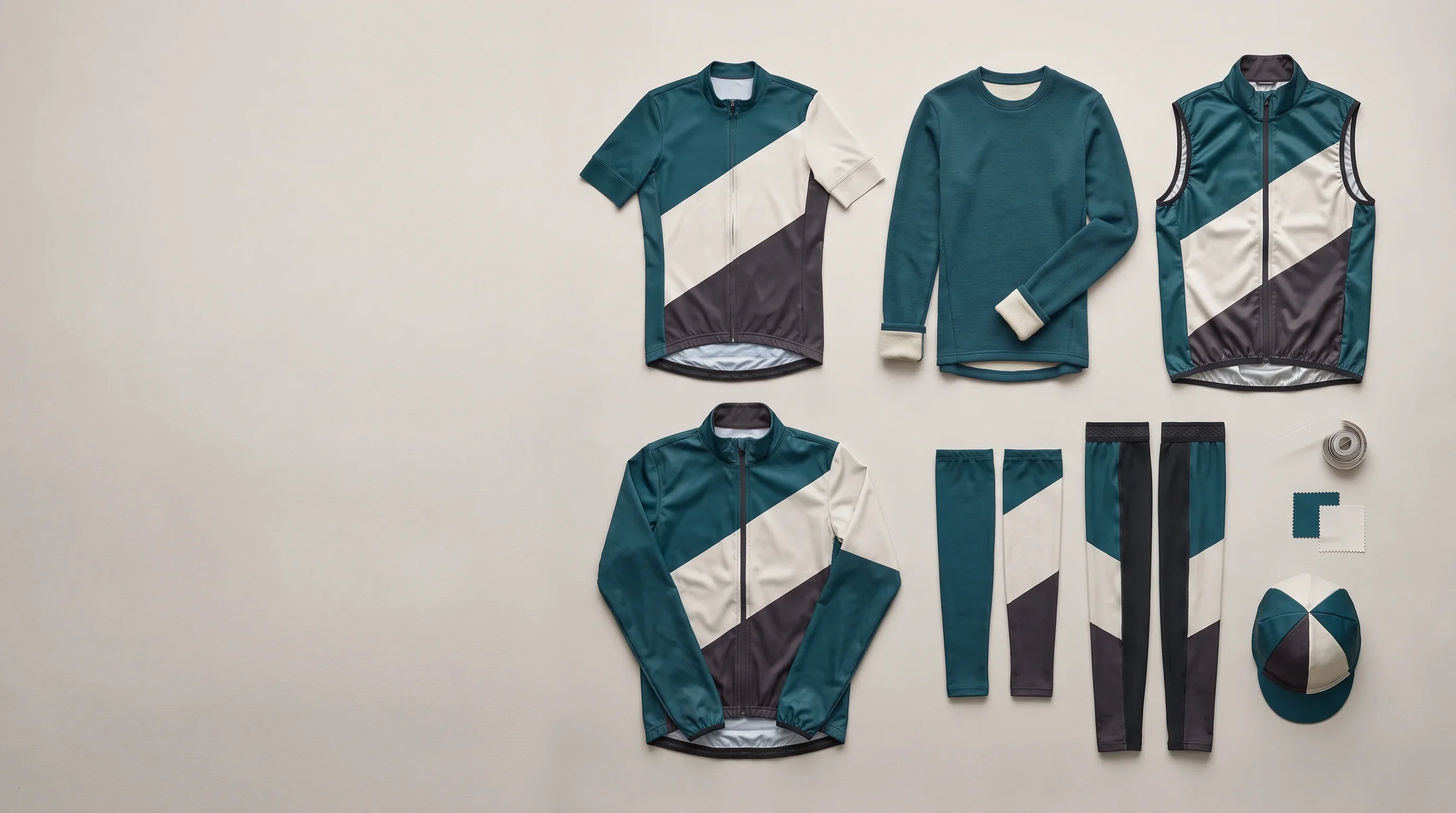
We develop race cycling apparel for the upper body and outer layers: short and long sleeve race jerseys, thermal jerseys, gilets, windproof jackets, arm and leg warmers and cycling caps, each one patterned, sampled and documented as part of one set.
The range is built for product leads at performance cycling brands planning a season line, technical leads at race teams dressing riders for the temperatures they race in, and technical directors at cycling federations running one colour standard across several squads.
Every garment in a project starts from the same riding-position block, every base fabric gets its own signed colour card against one colour standard, and every garment adds its own files to a single spec pack. Bib shorts, bib tights, skinsuits and tri suits are developed and sampled to your pad supplier's specification.
What you can count on in every project:
- A first sample in 5–7 days.
- Up to 2 revision rounds on a sample with no extra sampling fee.
- One signed colour card for each base fabric in the set, all matched to one D65 colour standard.
- Development run under ISO 9001:2015, on fabrics certified to OEKO-TEX® STANDARD 100.
Race Cycling Apparel Range by Garment, Temperature Band and Fabric Finish
The range sits in three tiers.
Developed in full, pattern to spec pack:
race fit jerseys in short and long sleeve, thermal jerseys, gilets, windproof jackets, arm and leg warmers, cycling caps, and any coordinated set built from them.
Developed and sampled to your pad supplier's specification:
bib shorts, bib tights, skinsuits and tri suits.
Through our two sister sites:
bulk production of a signed spec pack at cyclingapparelfactory.com, and team ordering at teamcyclingkits.com.
All garments share the binary nylon-spandex blends 88/12, 90/10 and 91/9. The temperature band decides the finish.
| Garment | Temperature band | Fabric finish | Detail |
|---|---|---|---|
| Short sleeve race fit jersey | Above 22 °C; 16–22 °C | Lightweight summer mesh; mid-weight stretch main body | Race fit jersey page |
| Aero short sleeve jersey | Race-specific | Main body with textured-surface knit on sleeves and shoulders | Aero development page |
| Long sleeve race fit jersey | 10–16 °C | Mid-weight stretch main body | Race fit jersey page |
| Thermal jersey | 10–16 °C | Brushed-back thermal main body | This page |
| Gilet | 16–22 °C on descents; 10–16 °C | Windproof laminate front, mesh or main-body back | This page |
| Windproof jacket | 5–10 °C | Brushed-back thermal body and sleeves, laminate front | This page |
| Arm and leg warmers | Arm warmers on 16–22 °C descents; both at 10–16 °C and 5–10 °C | Brushed thermal or main body | This page |
| Cycling cap | Above 22 °C | Mesh or main body | This page |
Race Fit Jerseys in Short and Long Sleeve, With Aero as a Short Sleeve Development Direction
The race fit jersey is the base garment of every set. It is patterned on a riding-position block and graded to the size chart you confirm.

Short sleeve:
lightweight summer mesh for races above 22 °C, mid-weight stretch main body for 16–22 °C.
Long sleeve:
mid-weight stretch main body for 10–16 °C.
Aero:
a development direction of the short sleeve jersey, starting from the same block, with seam placement, panel direction and sleeve fabric worked for a held race position.
The fit checks, construction by zone and grading are on the race fit cycling jersey page. The aero tiers are on the aero jersey development page.
The block drafted for the jersey is the block every outer layer in the same project is drawn on.
Garments Set by the Four Temperature Bands You Race In
The range is split into four temperature bands. For each band we set the garments riders race in and the fabric finish of each garment, so a team or federation can dress a squad for its race calendar from one table.
Above 22 °C
Short sleeve jersey, cap
Lightweight summer mesh
16–22 °C
Short sleeve jersey; gilet or arm warmers added for descents
Mid-weight stretch main body; laminate front on the gilet
10–16 °C
Long sleeve jersey or thermal jersey, or a short sleeve jersey with arm and leg warmers; laminate-front gilet
Main body or brushed-back thermal; laminate
5–10 °C
Windproof jacket, arm and leg warmers
Brushed-back thermal with laminate front
Each garment sits in its band for a set reason:
- The cap belongs to the warmest band, in mesh or main body.
- The gilet carries the laminate front. It covers the chest on descents at 16–22 °C and becomes part of the standard layer at 10–16 °C.
- The thermal jersey is the long sleeve option in brushed-back fabric for the 10–16 °C band. It has no laminate, so a gilet goes over it when the race needs a windproof front.
- The windproof jacket combines the brushed-back body with a laminate front for the coldest band.
- Arm and leg warmers carry a short sleeve jersey down into cooler bands, and they stay in the set at 5–10 °C under the jacket.
Tell us the bands your calendar covers, and the feasibility review lists the garments and fabric finishes per band.
The band you name also fixes the number of base fabrics in the set, and with it the number of colour cards, set out further down this page. Full layering by temperature will have its own page on this site.
Thermal Jersey in Brushed-Back Fabric for the 10–16 °C Band
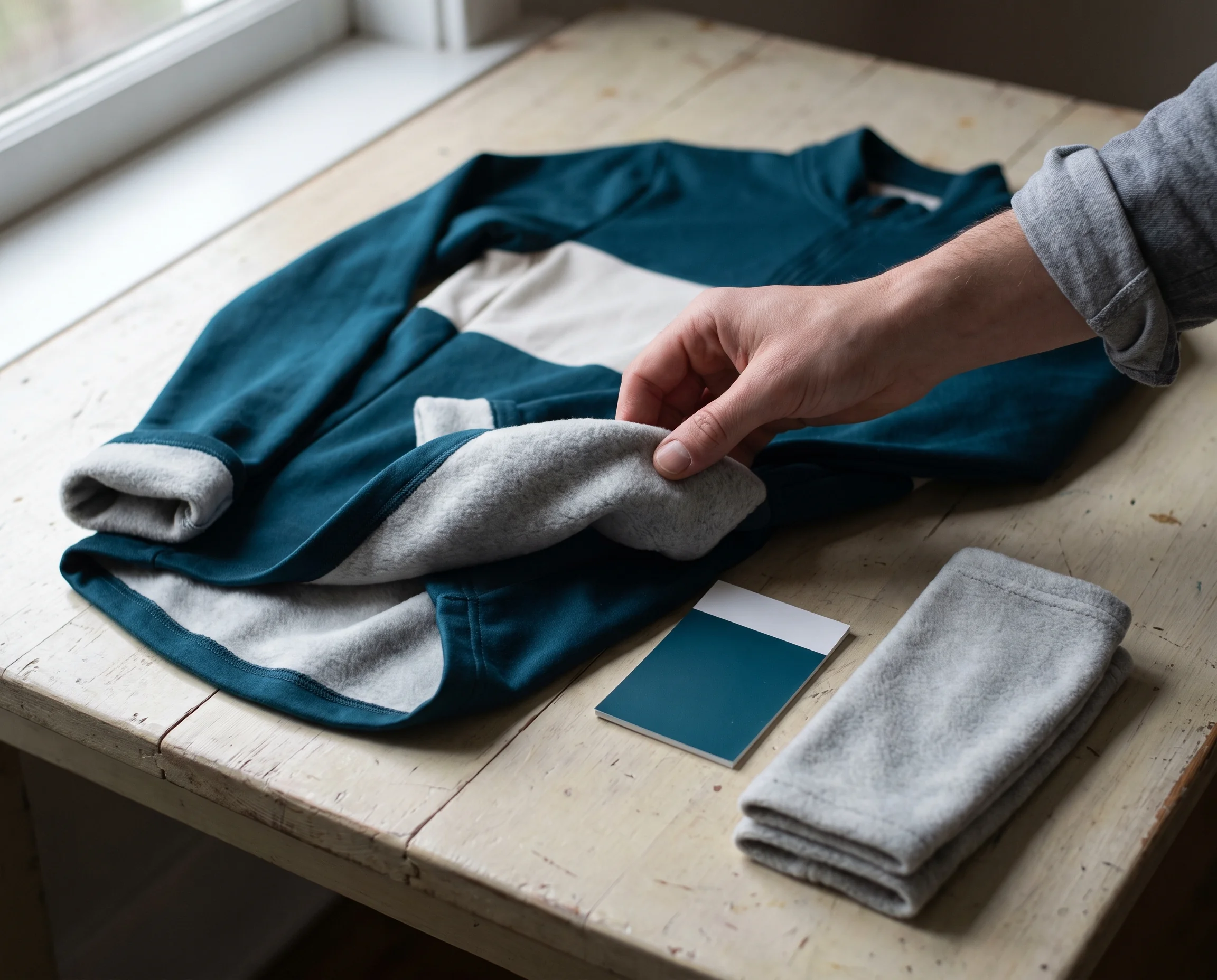
The thermal cycling jersey is a long sleeve race jersey in brushed-back thermal main body, with no laminate.
Pattern
the same long sleeve race fit pattern on the riding-position block, with no layering ease added. It is worn as the jersey, not over one.
Band
the long sleeve option of the 10–16 °C band.
Pairing
a laminate-front gilet goes over it on days that need a windproof chest.
Decoration
full sublimation, heat transfer and reflective print.
The brushed-back fabric is the same base fabric used in warmers and the windproof jacket, so the three garments share one colour card.
Gilet With a Windproof Laminate Front, Cut to Sit Over the Jersey
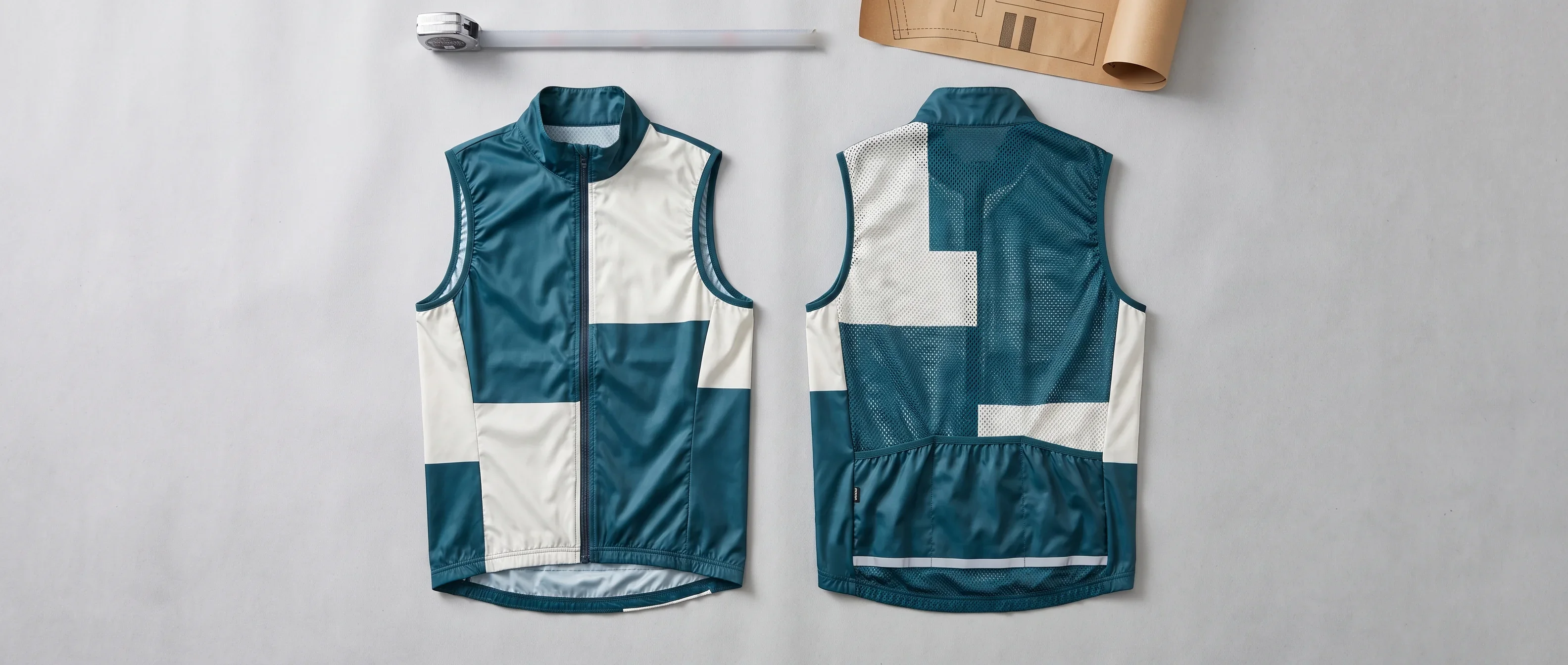
The cycling gilet is a sleeveless outer layer with a windproof laminate front and a mesh or main-body back.
Bands:
carried on descents at 16–22 °C, and worn as part of the standard layer at 10–16 °C.
Pattern:
drawn on the jersey's riding-position block with layering ease, as described in the next section.
Fabric by panel:
laminate on the front panels; mesh or main body on the back, confirmed by you in the fabric-by-panel sheet.
Decoration:
full sublimation, heat transfer and reflective strips.
The laminate front is its own base fabric, so a gilet adds one colour card to a set that had none in laminate.
Gilets and Jackets Drafted on Your Jersey's Riding Block, Then Fitted Over the Jersey Sample
The gilet and the windproof jacket are drafted from the same riding-position block as the race jersey in the same project. We do not start a separate block for the outer layers.
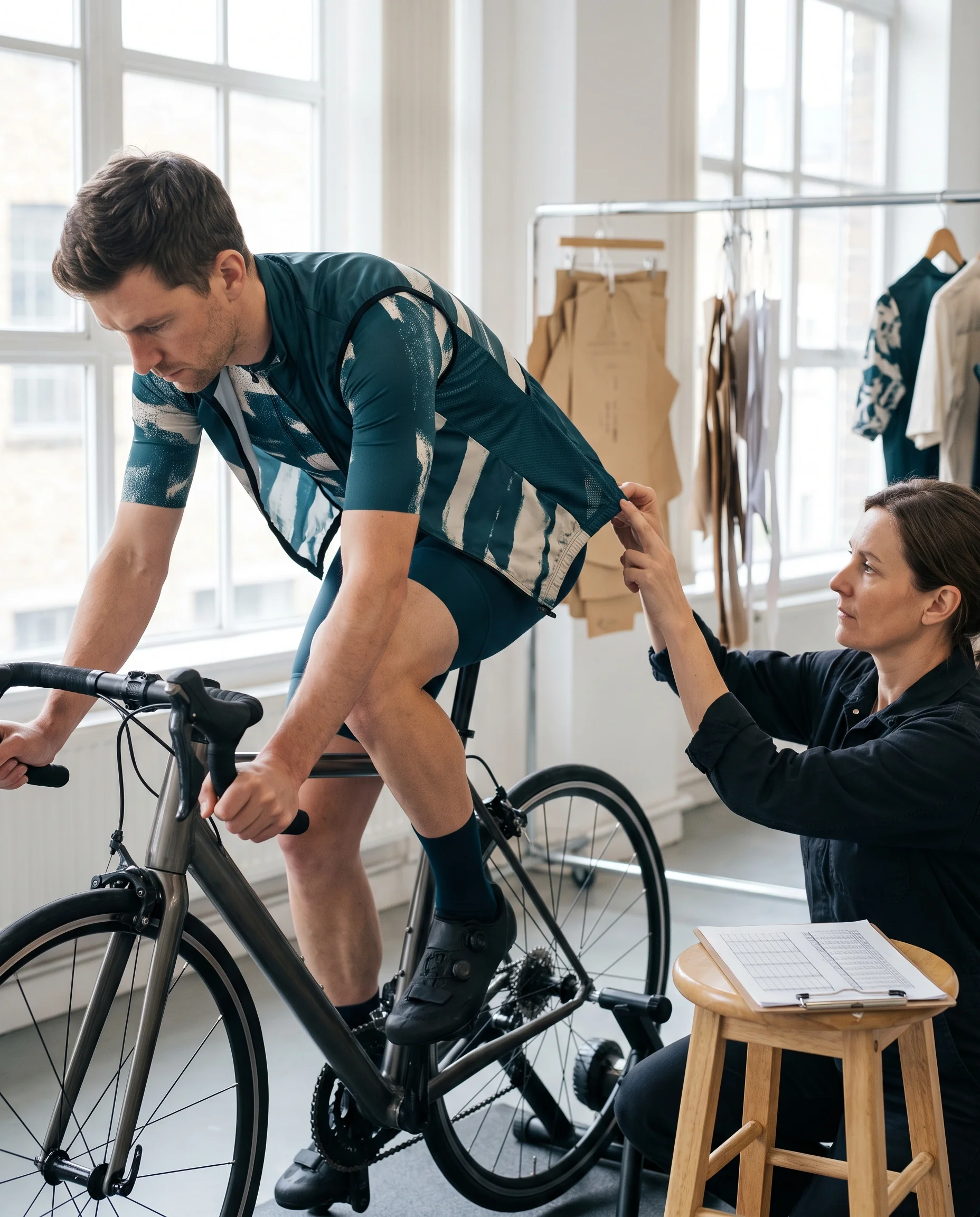
The pattern maker adds layering ease to that block so the outer layer sits over the jersey. Everything else on the block stays:
- The shorter front and longer back of the riding position.
- The collar dropped at the front.
- The panel logic of the jersey, so seams and decoration on the two garments line up.
The amount of ease is set by the pattern maker against your brief and drawn on the outer layer's own cutting diagram. You can lay the gilet or jacket cutting diagram over the jersey cutting diagram and see the same block underneath.
The fit check is done the way the garments will be raced:
- The outer-layer sample is put on over the jersey sample from the same project.
- The rider takes the race position on the bike.
- The four on-bike points from the jersey check are checked again, now through both layers.
- Each point is marked pass or return in the fit sign-off column of the measurement report, and the pattern maker signs it.
A returned point names the panel it goes back to, and the change is logged before the next sample.
What you hold at the end:
- The gilet or jacket cutting diagram, drawn on your jersey's block.
- The measurement report for the outer layer, with the fit sign-off column completed from the check worn over the jersey.
- The jersey and outer-layer samples in the sample set, so you can repeat the check with your own riders.
This is how a brand, team or federation knows the outer layers will fit over the jersey before the set is produced. The thermal jersey is the one long sleeve garment that keeps the jersey pattern with no layering ease, because it is worn as the jersey.
Windproof Jacket for the 5–10 °C Band, Brushed-Back Body With Laminate Front
The windproof jacket is our winter cycling jacket for the coldest band in the range.
Fabric
brushed-back thermal main body for the body and sleeves, windproof laminate on the front.
Band
5–10 °C, worn with arm and leg warmers.
Pattern
the jersey's riding-position block with layering ease, checked worn over the jersey sample as set out above.
Decoration
full sublimation, heat transfer and reflective print.
Because the jacket uses the brushed-back and laminate base fabrics, it shares colour cards with the thermal jersey, warmers and gilet in the same set.
Arm and Leg Warmers Sized to the Jersey Cuff and to Your Size Chart
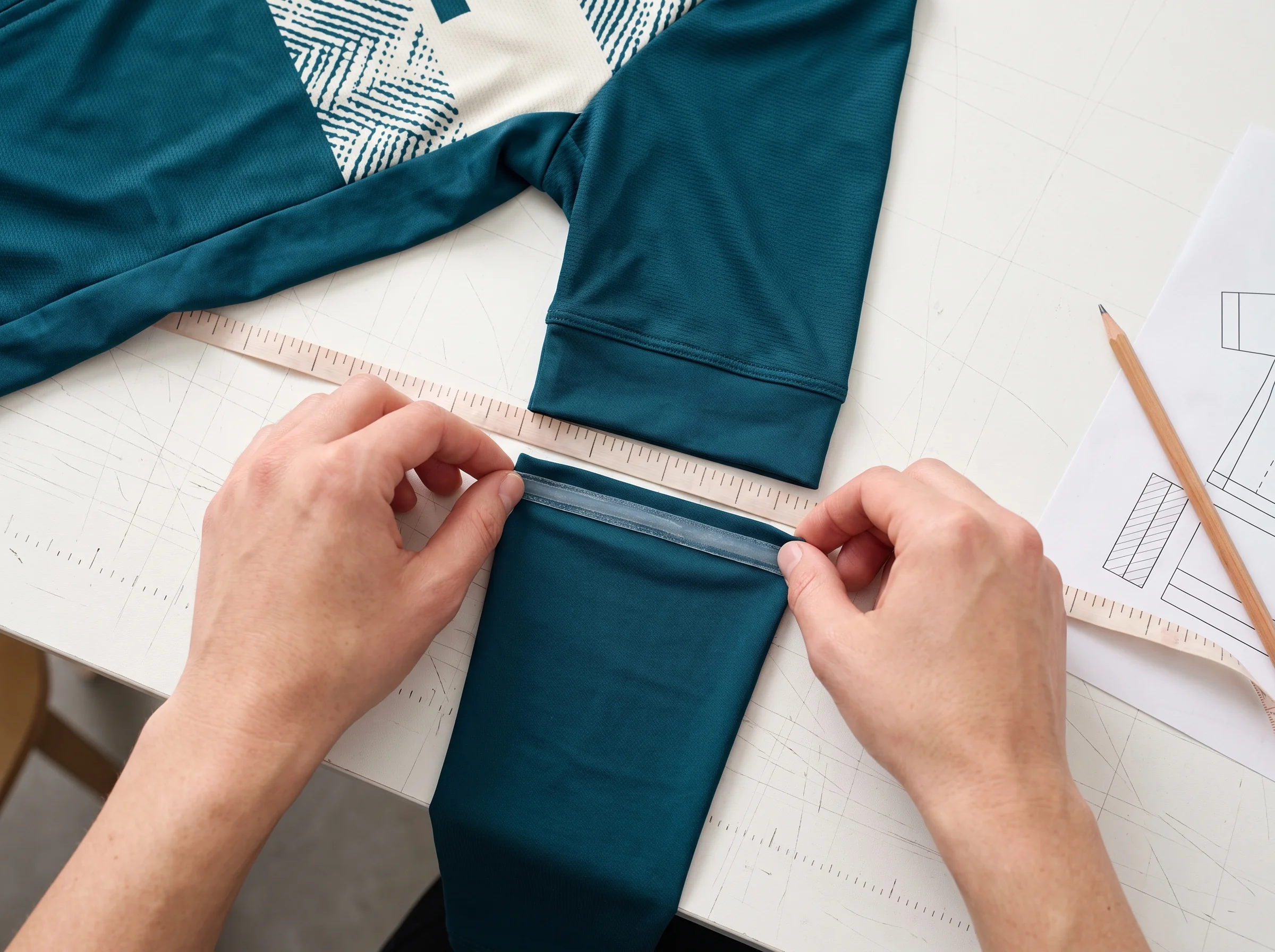
We develop cycling arm and leg warmers in brushed thermal or main body, with a silicone gripper band at the top opening.
Arm warmers are sized in pairs with the jersey:
- Each arm warmer size is matched to one jersey size in the same project.
- The top opening of each arm warmer size is set to the sleeve cuff of the matching jersey size.
- The arm warmer measurement report lists each top opening next to the matching jersey cuff measurement, signed by the sample technician.
Leg warmers are graded on their own to the size chart you confirm, with the same silicone gripper band at the top.
Warmers carry a short sleeve jersey through the 16–22 °C descents and into the 10–16 °C band, and stay in the set at 5–10 °C under the jacket.
Send the Garments and the Bands You Race In
List the garments you need and the temperature bands your races cover. We reply with the set per band, the fabric finish for each garment and the number of colour cards the set needs.
Cycling Cap Developed as Part of the Set, With Construction Options You Confirm
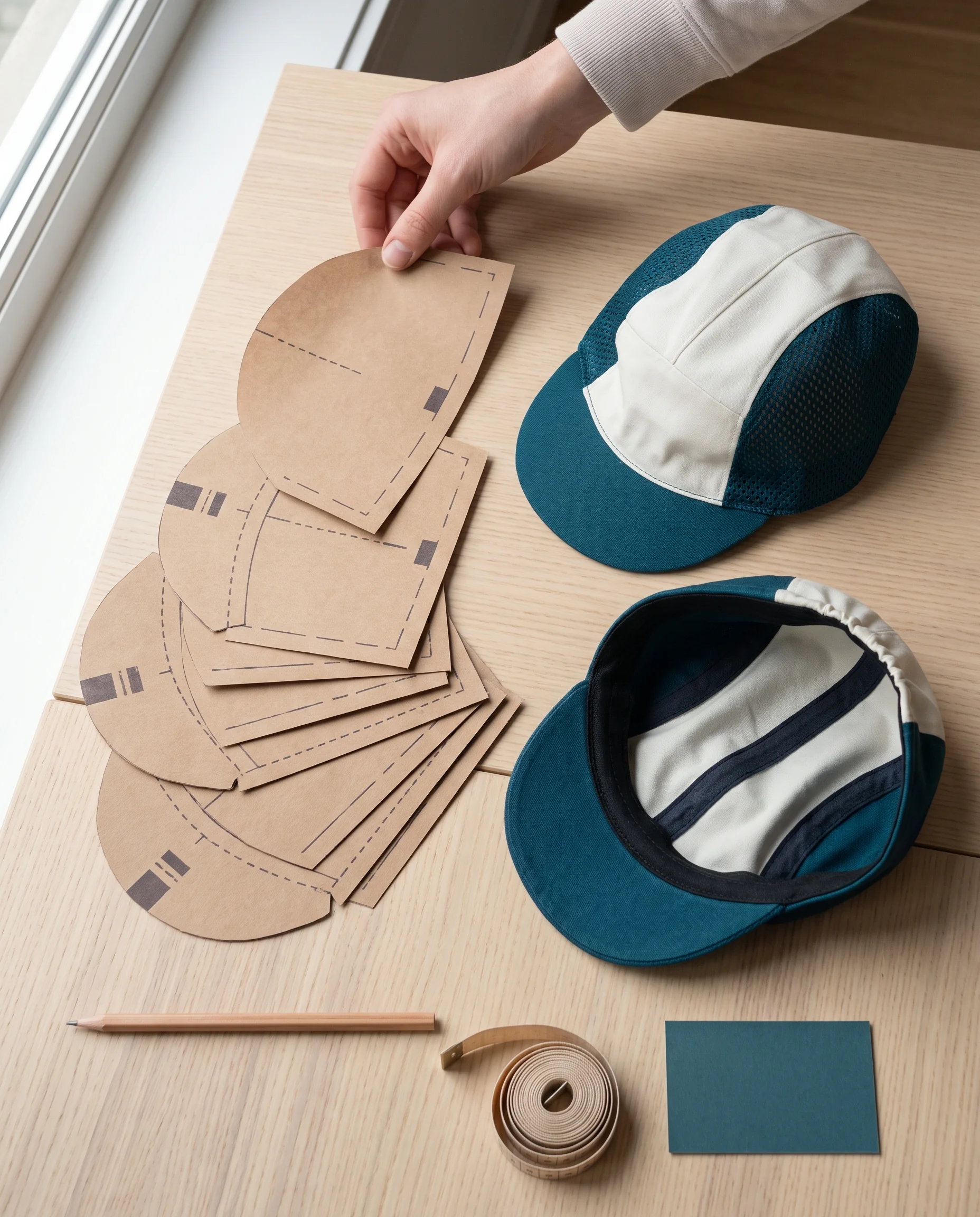
We develop the cycling cap as one garment of the set, for the warmest band. Every construction point is an option you confirm.
Panels:
the pattern maker proposes how the crown is divided and which panels are in mesh and which in main body, written into the fabric-by-panel sheet.
Brim:
a soft brim that flips up, or a firmer brim, chosen by you.
Sweatband:
in one of the base fabrics already in the range, confirmed by you.
Sizing:
graded to the head-size chart you confirm, or made as one size.
Decoration positions:
front panel, side panels, back panel, brim top and brim underside, in full sublimation or embroidery, drawn on the placement sheet.
Colour on the cycling cap follows the set. If the cap uses a base fabric already signed for the jersey or gilet, it takes that colour card. If it uses a base fabric new to the set, that fabric gets its own strike-off and signed card.
The cap has its own cutting diagram, fabric-by-panel sheet and placement sheet in the spec pack, like every other garment.
One Colour Card per Base Fabric, Every Garment Matched to One D65 Standard
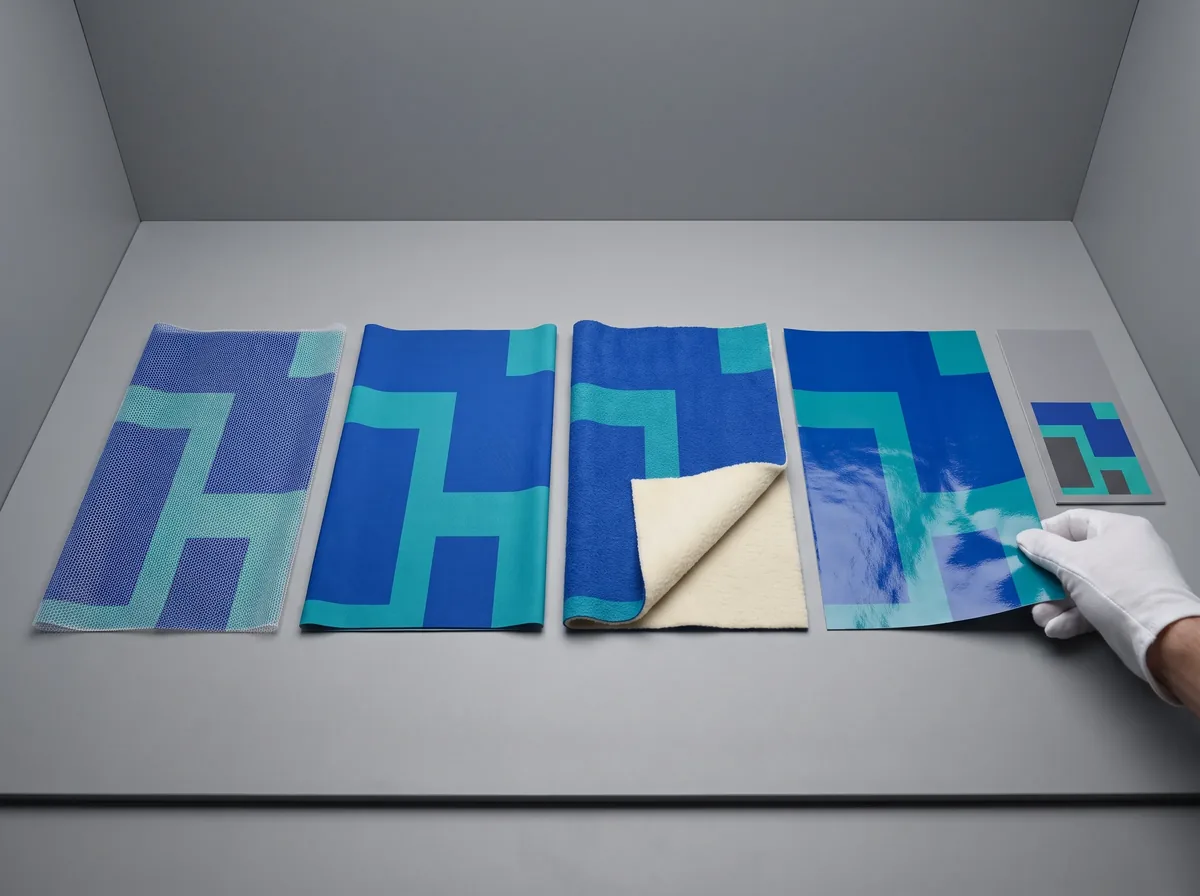
Colour cards are counted by base fabric, not by garment. Each base fabric used anywhere in the set gets one print strike-off and one signed colour card, and every card is matched to one colour standard under D65.
The steps:
- You send the colour standard for the set.
- The colour and print technician prints a strike-off on each base fabric in the set.
- Each strike-off is viewed under D65 against the same colour standard.
- Each base fabric gets one signed colour card, and its colour parameters are written into the spec pack.
A worked example for a set of four garments:
- Short sleeve jersey
- Mid-weight stretch main body, lightweight summer mesh
- Gilet
- Windproof laminate front, mesh back
- Arm warmers
- Brushed-back thermal
- Cap
- Mesh, using the card already signed
Four garments, four base fabrics: main body, mesh, laminate and brushed-back. That is four colour cards, and those four cards cover all four garments.
Adding a windproof jacket to this set adds no card, because its brushed-back and laminate fabrics are already signed. An aero jersey with textured-surface knit on the sleeves adds one.
How you check it:
- Take the fabric-by-panel sheet of every garment and list the base fabrics named on them.
- Remove the duplicates. The count equals the number of signed colour cards.
- Lay the cards side by side under D65 against your colour standard.
The colour and print technician signs each card. The colour parameters stay with the set, so a garment added in a later season is printed to the same parameters on the same base fabrics.
Decoration follows the same standard, in full sublimation, heat transfer, embroidery, reflective print or silicone grip, placed on each garment's placement sheet.
You know before sampling how many strike-offs the set needs, and the colours of a gilet and a jersey in different fabrics are matched to the same reference.
Bib Shorts, Bib Tights, Skinsuits and Tri Suits Developed to Your Pad Supplier's Specification
For garments built around a chamois pad, we develop and sample to the specification of the pad supplier you name.
Bib shorts and bib tights
We developPattern around the pad position, fabric by panel, compression band layout, sample
You bringPad supplier specification
Skinsuits for time trial and track
We developOne-piece pattern on the pad position, fabric by panel, compression band layout, sample
You bringPad supplier specification
Tri suits
We developOne-piece pattern on the pad position, fabric by panel, compression band layout, sample
You bringPad supplier specification
These pieces use the same binary nylon-spandex blends and are matched to the same colour standard as the rest of the set. The development stops at signed samples and development files.
One Spec Pack for the Whole Set, With Each Garment's Files Listed Separately
A set is delivered as one spec pack. Each garment you add adds its own files inside the same eight-part structure:
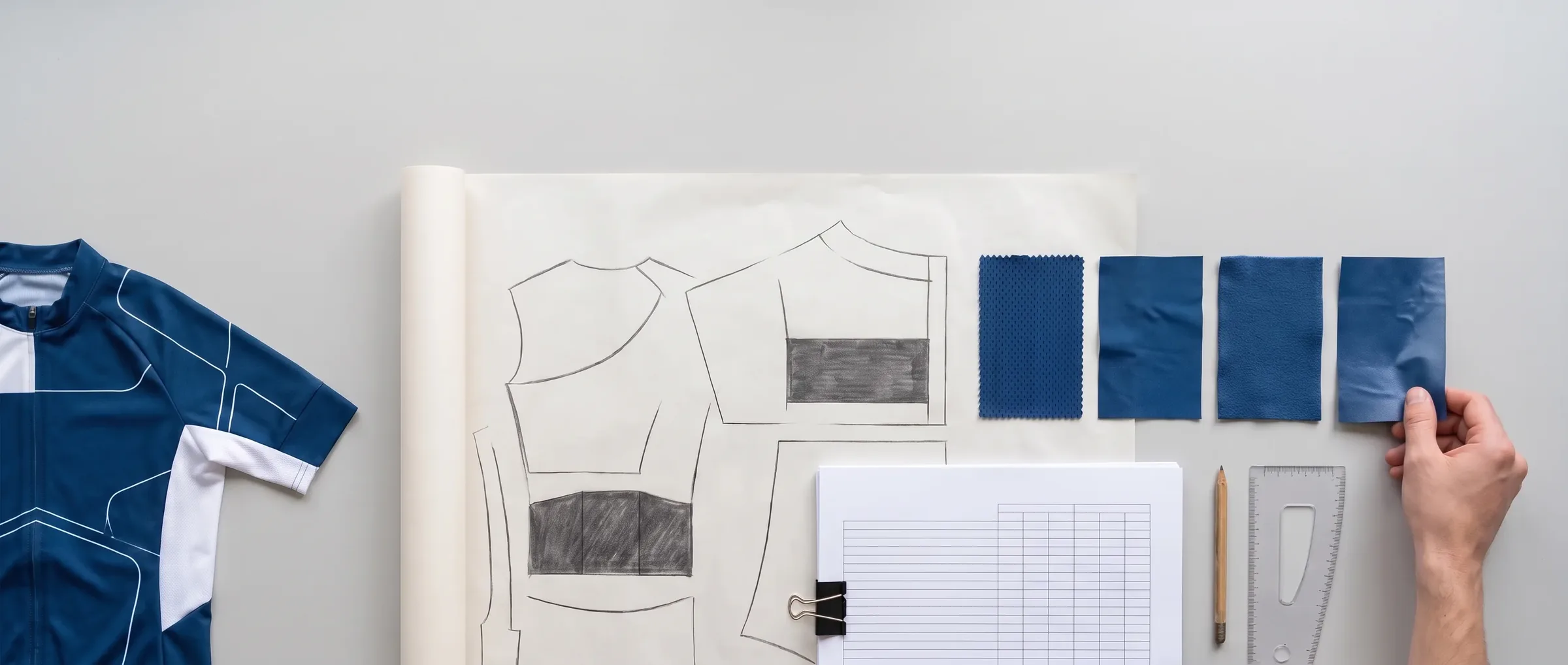
- Cutting diagram.
- Graded pattern.
- Fabric-by-panel sheet.
- Decoration placement sheet.
- Size chart.
- Seam type description: flatlock at contact zones, four-thread overlock on main body joins.
- Its sample in the sample set.
Colour cards and colour parameters are listed once per base fabric and shared by every garment that uses that fabric.
Who signs what across the set:
- The pattern maker signs fit for each garment, including the outer layers checked over the jersey.
- The sample technician signs the measurement report that ships with each sample.
- The colour and print technician signs the colour card for each base fabric.
- The development manager issues the spec pack once every garment is signed.
The revision record runs across the whole set. Each entry names the garment, the panel, what changed and why, so a change to the gilet back panel is never confused with a change to the jersey back panel.
How you check it:
- Take your garment list.
- For each garment, find its six documents and its sample in the sample set.
- Check that every base fabric named on a fabric-by-panel sheet has its signed card in the colour section.
- Check that each revision entry names a garment and a panel.
- Check that each sample in the sample set carries its signed measurement report.
The pack is production-ready. Your own production line can run the whole set from it, or bulk can be placed through cyclingapparelfactory.com from the same files.
What this gives a brand or federation: the jersey, gilet, jacket, warmers and cap go into production from one set of documents, on one block and one colour standard, rather than from separate files for each garment.
Start With One Garment and Add the Rest From the Same Pack
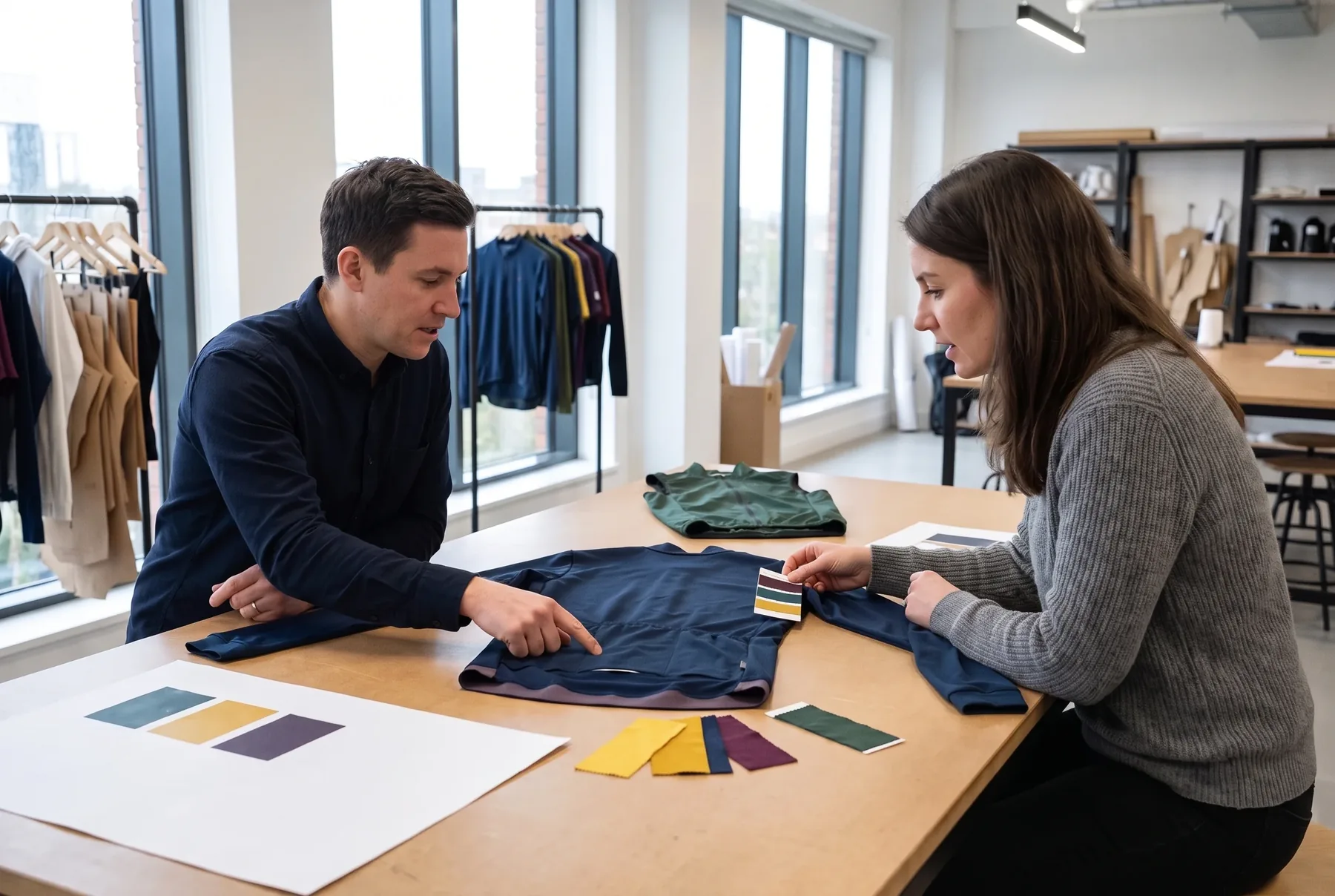
A set does not have to be developed in one go.
-
Start with the jersey,
and the riding-position block, colour cards and spec pack are in place.
-
Add a gilet or windproof jacket later,
and it is drafted on the same block with layering ease.
-
Add warmers later,
and they are sized to the jersey cuffs already in the pack.
-
Add a cap later,
and it takes the colour cards already signed where its fabrics match.
We keep the spec pack, colour parameters and revision record on file for each project, so the next season or the next garment starts from the same documents.
Information to Send for a Feasibility Review of Your Range
Send what you have. The more of this list you include, the more specific the review.
Garments:
which of the six garments, and any bib shorts, bib tights, skinsuits or tri suits.
Race formats and temperature bands:
road race, criterium, time trial, and the bands your calendar covers.
- Size chart and size range for each garment, and the men's and women's versions you need.
- Colour standard and artwork for the set.
- Reference garments you want us to start from, if any.
- Pad supplier specification, for any bib or one-piece garment.
- Any wind tunnel or track test results, for an aero jersey.

We reply within 24 hours on working days. Within 48 hours of a complete brief, the development manager sends a development feasibility review covering:
- Whether each garment can be developed to your specification.
- The block, fabric finish and decoration direction we recommend for each garment.
- The base fabrics in the set and the number of colour cards.
- The next step: how the first samples are scheduled.

Related Pages and Our Two Sister Sites
Race fit jersey
the riding-position block every garment in a set starts from.
Aero jersey development
seam placement, panel direction and sleeve fabric for the short sleeve race jersey.
About us
the development team and who signs each stage.
Home
our development service and process.
Bulk production of a signed set runs at cyclingapparelfactory.com. Team ordering runs at teamcyclingkits.com.

Send Your Garment List and Race Calendar
Tell us the garments, the temperature bands and the size chart. The development manager comes back with the set per band, the colour cards it needs and a sampling plan.